Saturday, September 24, 2011

Casa Rural in Sanxenxo

We have arrived at our second Casa Rural and it is beautiful...dream-like, really.  Especially for me because there are sheep, chickens, a rooster, a vegetable garden, a traditional gallego horreo and a vineyard with grapes still on the vine.

Manolo and Rosi are the owner-operators and this property has been in Manolo's family for generations, it originally belonged to his great-grandparents.  There are 2 large homes on the property as well as a smaller house where Manolo's mother lives.  One of the larger homes is where Manolo and his family live and the other large house has been restored and converted into a bed-and-breakfast.  Manolo and Rosi both work full-time and their daughter attends the university in Santiago, they also have a teenage son.

As you can see from the pictures posted below, the house and property are beautiful and - more importantly - easy to find and accessible with a normal car.  It feels like we are in a very remote location but in reality we are 10 minutes from one of the most beautiful beaches in all of Spain and centrally located, with access to many sites in the Rias Baixas (Lower Estuaries) area of Galicia.  A good home base for a few days of exploring.


The entrance to Casa Ameneiros


Panoramic view of the b&b house - click to enlarge

Nana on the front porch - we have the whole place to ourselves


The front porch


Nana in our bedroom

Our bathroom - plenty of head room

Bedroom window

View of the vineyards from the bedroom window

My sheep (at least for 4 days)

My vineyard - the supports are wood and Galician granite

My grapes
All over Galicia you see ho'rreos - elevated granaries where people keep/kept their grains, potatoes, even seafood in short-term storage to protect from the elements and from vermin.  Traditionally they are made of either stone (Galician granite) or wood and elevated on stone columns and have red tile roofs.  They usually have a cross or some other type of decor on the end of the roof.
My horreo


Another shot of my horreo

My rooster

My vegetable garden

Apples on a bench
 More views of the inside of the house:


Leaving La Coruna - or not?

Nana loves La Coruna so much that she just might move here - and if she does I found her new hang out:

Translation:  Club of Retired Folks.  I wonder if they have ping pong tables?


Iglesia Santiago de la Coruna


 While strolling in the casco antiguo (ancient quarter) we found the Iglesia de Santiago, the oldest church in La Coruna.  A Romanesque-Gothic church dating back to the 12th and 15th century, with 2nd century  Roman stones from the Torre de Hercules incorporated into the structure.


This church is a typical mariner's church in that the unusual wooden ceiling resembles the bow of a ship. An interesting fact the docent mentioned is that over 150 people are buried under the church.  In order to fit that number of people they had to be measured and were buried standing up, shoulder to shoulder.


The wooden ceiling of the church


The main alter contains arches with no supporting columns

We were very fortune this church had a docent because there were so many details she pointed out, such as the grafitti-like carvings the original stone masons made as they constructed the church.  They carved religious symbols such as angels, scalloped shells representing Santiago (St. James) and crosses, as well as symbols representing La Coruna, such scissors for the many tailors, boats for the fishermen and stars for the night sky. 
The carving above is of a fisherman in his boat rowing with oars


The mariner theme is also represented in the carvings of mermaids and mermen in this supporting column.

The statues of the Virgin Mother created by Galician artists traditionally depict Mary as very human and accessible.  She is shown here as La Virgen de la Leche nursing the infant Jesus, as well as an unusual depiction of her very pregnant and wearing traditional Gallego peasant shoes and scarf.


Friday, September 23, 2011

Maria Pita

When we entered one of the largest and most beautiful plazas in La Coruna and found out it was named after a non-royal woman, I had to find out who Maria Pita was and why she was held in such high esteem. Plus, our beloved Melia hotel bears her name.  As it turns out, she lived quite an interesting life (married 4 times and lived to be in her 80s in the late 1500s - holy smokes!).
So, we searched out her home, which is now a museum, to find out more about this Galician heroine.  It turns out that Maria Mayor Fernandez de Camara y Pita (Maria Pita) helped defend La Coruna against the invading British Armada, led by Francis Drake.  She was eventually honored by the King of Spain who gave her a military officer's pension - a true rarity in that time for a woman.  Her heroism inspired many others, which is her true mark in history.


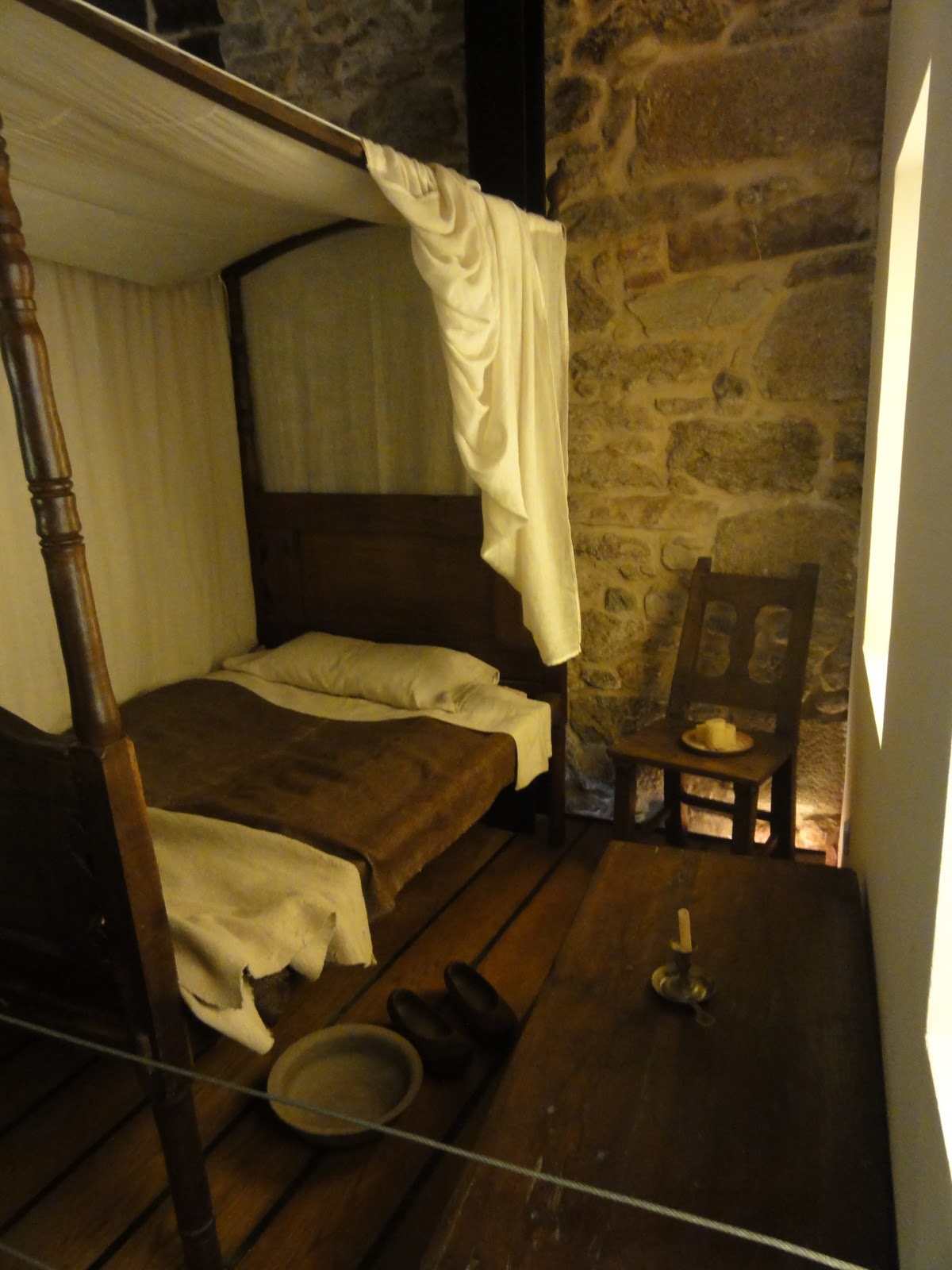
The most interesting thing about Maria Pita's home-museum was that when she died they performed a complete inventory of all the belongings found in her home.  For the casa-museo they gathered objects from the time period of her life (1554-1643) and re-created her household using the items on the inventory list.  A few of these photos are dark, but in general you can see how humbly the people of those times lived.


A timeline of her life, in gallego:


A historical narration school book telling the story of Maria Pita:


La Torre de Hércules

One of the iconic symbols of La Coruna is the Tower of Hercules, of unknown origin but rebuilt by the Romans in the 2nd century and then rehabilitated again in the late 1700s.  It is believed to be the oldest lighthouse in existence in the world today.
One myth regarding the origin of the Tower of Hercules from Wikipedia:
"Through the millennia many mythical stories of its origin have been told. According to a myth that blends Celtic and Greco-Roman elements, the hero Hercules slew the giant tyrant Geryon after three days and three nights of continuous battle. Hercules then—in a Celtic gesture— buried the head of Geryon with his weapons and ordered that a city be built on the site. The lighthouse atop a skull and crossbones representing the buried head of Hercules’ slain enemy appears in the coat-of-arms of the city of La Coruna."

Cupula Atlantica
We walked to the tower and took a few pictures, but the best are the ones we took from the viewpoint on a hilltop across the bay.  We went up to the Cupula Atlantica which featured an enclosed building (thankfully - it was so windy outside I was afraid Nana was going to blow away!!) with windows imprinted with interesting information about the various sites you can see from the cupula.  It was a perfect day for the 360 degree views!


Nana has the tower in her hand - don't drop it Nana!!

When we arrived at the Tower there were two guys playing gaitas, which added to the ambience.


A beautiful park surrounds the tower, with trails to walk and plenty of places to play and fly kites in the strong wind.